

With support from the Lombardy Region under the NEXT FASHION Call, MTM S.r.l. is participating in the PHYS-EX – Physical Hybrid Intelligent Sportswear Experience, an experimental development initiative dedicated to innovation in the “Textiles, Fashion and Accessories” sector.
The project is implemented with resources from the European Union, the Italian State and the Lombardy Region, under the Lombardy ERDF Regional Programme 2021–2027, Action 1.1.3 “Support for the implementation of complex research, development and innovation projects” and Action 1.3.3 “Support for SME investments”.

PHYS-EX
Beneficiary: MTM S.r.l.
Call: NEXT FASHION
Axis 1 – “A MORE COMPETITIVE AND SMARTER EUROPE”
Specific Objective 1.3 “Strengthening sustainable growth and competitiveness of SMEs and job creation in SMEs, including through productive investments”
Short description: Development, integration and technical validation of smart sports-shirt prototypes through system-integration activities, pilot assembly, mechanical and electronic testing, interoperability trials and field testing with selected teams and athletes.
Objectives
PHYS-EX was conceived to contribute to the evolution of the Textiles, Fashion and Accessories sector by developing a smart sports garment that combines technological innovation, environmental sustainability and a concrete focus on the end user.
In particular, the project aims to:
- develop smart sports shirts equipped with integrated sensor modules;
- design lightweight, durable internal components compatible with sports use;
- test the use of eco-friendly materials and 3D-printed solutions;
- facilitate disassembly, maintenance and selective recycling of electronic components;
- reduce waste, integration defects and premature obsolescence of technical garments;
- create a replicable demonstrator platform for future smart clothing lines;
- strengthen collaboration among technology companies, creative businesses, digital specialists and operators in Lombardy’s fashion-tech supply chain.
The project goes beyond creating a technology-enabled shirt, experimenting with a new relationship between the physical product and the digital service, in which the garment can collect data, interact with a software platform, be updated over time and retain value throughout its entire life cycle.
MTM’s contribution
PHYS-EX is based on developing a new generation of smart sportswear designed for use in real sports settings without compromising comfort, freedom of movement or athletic performance.
MTM’s contribution focuses in particular on the system integration and technical validation of the PHYS-EX prototypes. The activity aims to transform the modules developed by the partners into a coherent, stable system ready for field testing by integrating hardware, firmware and the Physical AI platform.
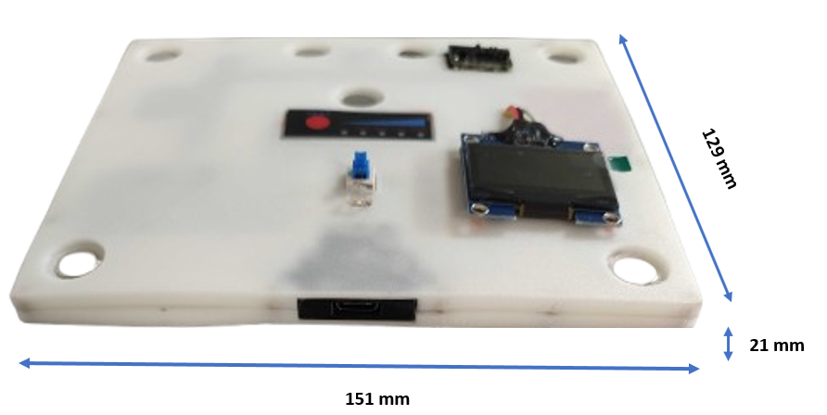
Dimensions of the hardware module used in the integration activities: 151 × 129 × 21 mm.
Based on the specifications provided by Techinnova and SNJ Media Studio, MTM defines wiring layouts, attachment points for the internal modules and power interfaces, with particular attention to resistance to impacts, repeated tensile loads and washing. The objective is not simply to make the shirt work, but to ensure its reliability throughout its intended life cycle, preventing progressive degradation of sensor performance.
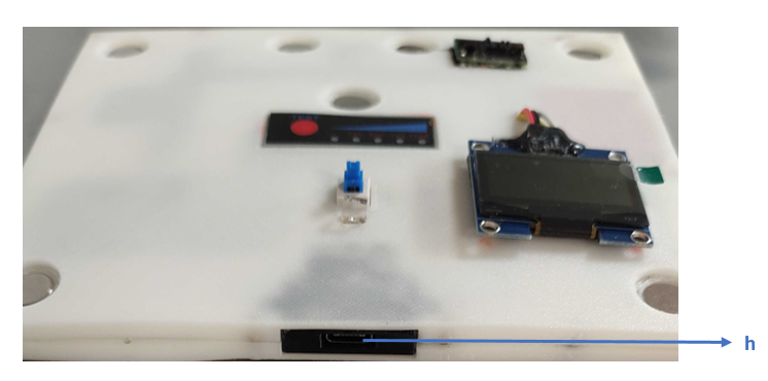
Detail of the module’s charging interface: (h) charging port.
MTM sets up a pilot assembly line to refine the prototype assembly processes, introducing standardised procedures for handling components 3D-printed with the patented resin (EP4255984). The activities include dimensional tolerances, incoming quality checks, rapid electrical tests, mechanical-resistance testing and routine garment-maintenance procedures.
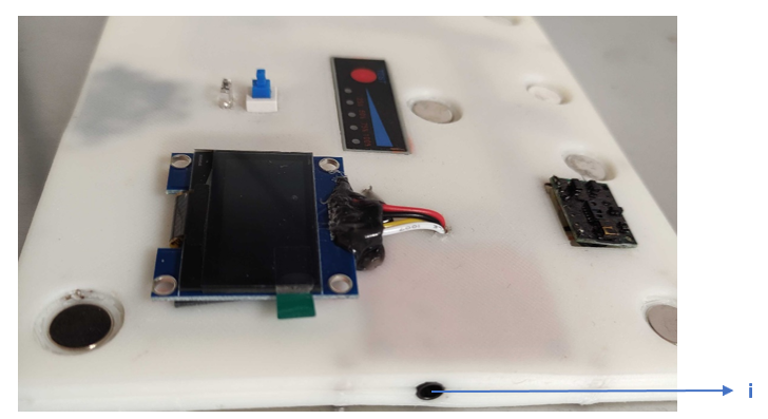
Detail of the ECG AD8232 sensor port: (i) connector for detecting the electrocardiographic signal.
On the electronics and software side, MTM carries out interoperability testing among the firmware, platform and mobile devices, verifying the continuity and security of sensor-data flows. The test sessions monitor latency, packet loss, error handling, radio interference, advanced logging tools and over-the-air firmware updates, including under suboptimal connectivity conditions.
The final phase involves field technical validation with selected teams and athletes in the region, observing the shirts’ behaviour during matches, interval-training sessions and individual workouts. The data collected are used to verify system stability, battery life and the robustness of communication channels, generating useful guidance for future industrialisation.
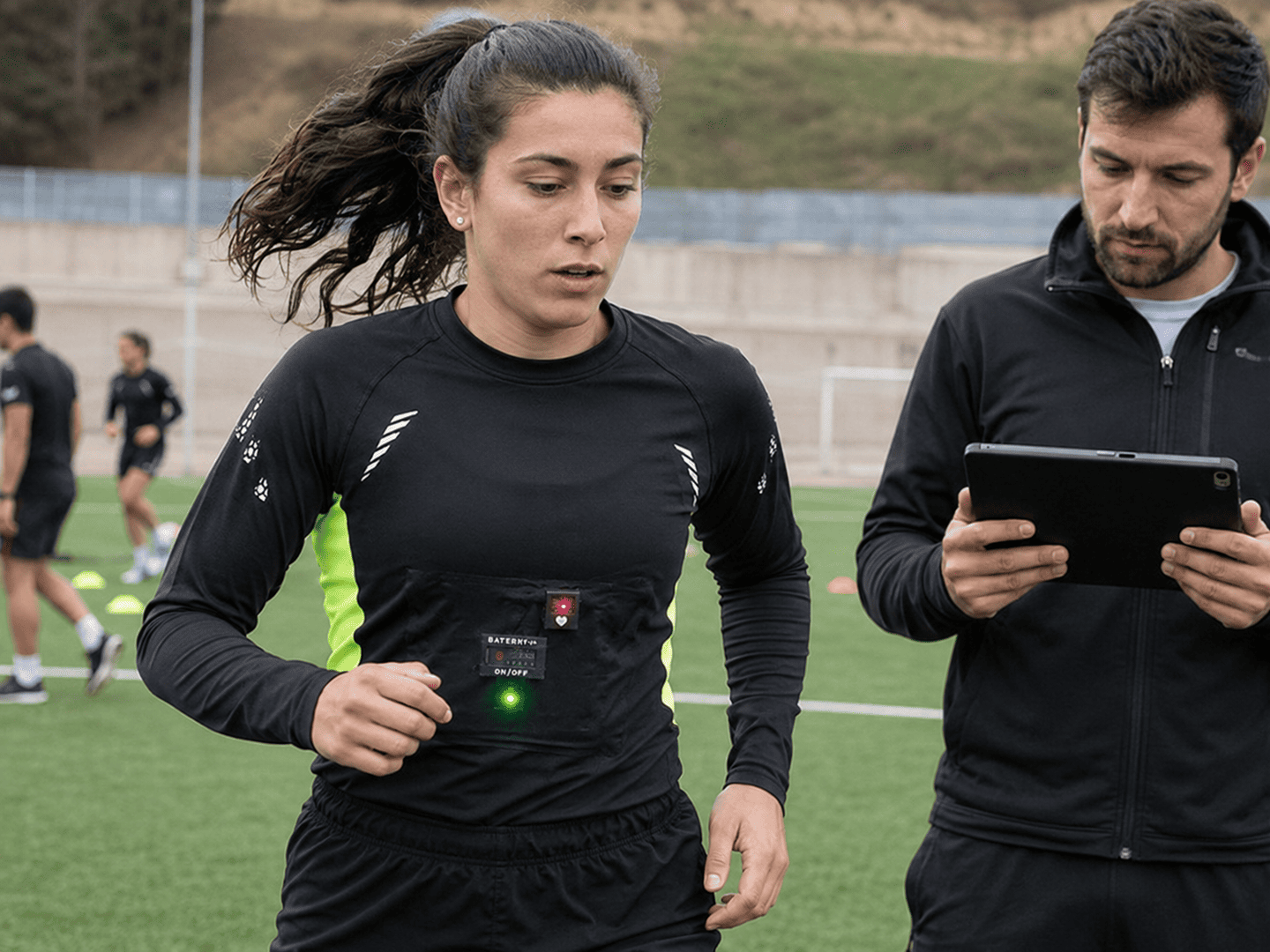
Initial field technical validation of the PHYS-EX smart shirt, with data monitoring during sporting activity.
Results
PHYS-EX supports the growth of a more innovative, sustainable and competitive regional supply chain by testing a smart technical garment designed to last longer, generate less waste and open new development opportunities for connected sportswear.
With regard to MTM’s activities, the main results include:
- the integration of hardware, firmware and the Physical AI platform;
- the definition of wiring layouts, attachment points for the internal modules and power interfaces;
- the setup of a pilot assembly line for assembling the PHYS-EX prototypes;
- the development of standardised procedures for 3D-printed components made with the patented resin (EP4255984);
- the definition of dimensional tolerances, incoming quality checks and rapid electrical tests;
- the performance of mechanical-resistance tests on completed shirts through stretching and compression cycles;
- the verification of interoperability among firmware, platform and mobile devices, including analysis of latency, packet loss, error handling and radio interference;
- field technical validation with selected teams and athletes, and the production of technical reports documenting issues, improvements introduced and guidance for future industrialisation.
Overall, the project aims to produce a replicable demonstrator platform for other lines of technical apparel, guidelines for integrating electronics and innovative materials while minimising environmental impact, and a stable collaboration model among Lombardy’s creative, digital and manufacturing businesses.
Partnership
The PHYS-EX project is developed by a partnership comprising SNJ Media Studio S.r.l., Techinnova S.p.A., MTM S.r.l. and TUTTOTONDO S.r.l., bringing together complementary expertise in software, research and development, materials, technology integration, communication, behavioural design and regional testing.




SNJ Media Studio S.r.l. – Lead Partner
SNJ Media Studio coordinates the development of the advanced firmware and the Physical AI Platform. Its activities cover real-time processing of multisensor data, energy-consumption optimisation, management of sensor protocols, development of Physical AI and Behavioral AI models, creation of an API layer for external developers, and integration of secure consent, data-flow and authorisation systems in line with GDPR and data-minimisation principles.
Techinnova S.p.A. – Partner Company
Techinnova is responsible for designing the sensor modules and the form factor of the smart shirts. The company works on integrating electronic components into the textile garment, using patented eco-friendly resin (EP4255984), producing 3D-printed internal microstructures, and carrying out preliminary validation through torsion, tensile, compression and signal-stability tests.
MTM S.r.l. – Partner Company
MTM is responsible for system integration and technical validation of the PHYS-EX prototypes. Activities include integration of hardware, firmware and the Physical AI platform; definition of wiring layouts and attachment points; setup of a pilot assembly line; quality controls; electrical and mechanical tests; interoperability testing; and field validation with selected teams and athletes.
TUTTOTONDO S.r.l. – Partner Company
TUTTOTONDO coordinates athlete engagement, behavioural nudging and participatory testing activities in collaboration with Università Cattolica. Its role includes designing engagement protocols, mapping use contexts, defining motivational micro-messages and micro-interventions, collecting qualitative feedback, involving teams, sports groups and volunteers, and producing guidelines to transfer the experience to other sports or educational settings.
WITH THE SUPPORT OF